What are the three types of ceramics?

Three Core Categories of Industrial Ceramics

In the modern high-end manufacturing sector, industrial ceramics have long shed the stereotypes of traditional ceramics. With their irreplaceable superior properties such as high temperature resistance, corrosion resistance, high hardness, insulation, and wear resistance, they have become core foundational materials for industries such as new energy, precision machinery, extreme sports, and biomedicine, earning the reputation of being the "hard skeleton of manufacturing." Unlike everyday ceramics, which are made from natural materials and have a more rudimentary manufacturing process, industrial ceramics are characterized by high-purity synthetic raw materials and precise manufacturing processes. They are divided into three main types, each corresponding to specific performance scenarios, providing crucial support for industrial upgrading across various sectors globally.


Oxide ceramics: the general mainstay of industrial ceramics, balancing performance and cost-effectiveness.

Oxide Ceramics are the most widely used and technologically mature category of industrial ceramics, and also the fundamental core materials in the industry. Primarily represented by alumina and zirconium oxide, they are considered "all-rounders" in industrial ceramics. Alumina ceramics, using high-purity Al₂O₃ as raw material, possess excellent mechanical strength, wear resistance, corrosion resistance, and insulation. With a mature firing process and relatively controllable costs, they are widely used in automotive braking, mechanical seals, and electronic insulation. The well-known alumina ceramic brake pads, with their low dust, quiet operation, and long lifespan, have become the preferred component for braking systems in mid-to-high-end passenger vehicles and new energy vehicles.


Zirconium Oxide Ceramics, as a high-end category of oxide ceramics, incorporate elements such as yttrium to stabilize their structure, possessing ultra-high toughness, high hardness, and an extremely low coefficient of thermal expansion. Even under extreme temperatures and highly corrosive environments, they maintain dimensional stability and are often used in precision fluid transport, biomedical devices, and high-end bearings. For example, zirconium oxide ceramic rotors, with their advantages of no ion precipitation, ultra-cleanliness, and wear resistance, perfectly meet the stringent requirements of high-precision industries such as semiconductors, pharmaceuticals, and food and beverage. Oxide ceramics, with their comprehensive performance and versatility, have become the most widely used type of industrial ceramics, covering the broadest range of applications.


Nitride Ceramics: high-Performance specialty ceramics, breaking through the limits of extreme working conditions

Nitride Ceramics are high-end specialty materials in industrial ceramics, with silicon nitride (Si₃N₄) as the core representative. With its superior high-temperature resistance, lightweight, and high strength compared to oxide ceramics, it has become a "trump card" material for dealing with extreme working conditions. Its density is only 40% of that of steel, yet its hardness reaches 2-3 times that of bearing steel. It also possesses excellent self-lubricating properties, insulation, and thermal shock resistance. Even in environments with high-speed rotation, strong corrosion, and alternating high and low temperatures, it can maintain stable performance, perfectly solving the pain points of traditional metal materials such as easy wear, easy rusting, and heavy weight.


In specific application areas, the advantages of nitride ceramics are irreplaceable. For example, our main product, silicon nitride ceramic bearings for skateboards, uses high-purity silicon nitride as the rolling element. Compared with all-steel bearings, it is nearly 60% lighter and has a significantly lower coefficient of friction, making skateboards glide more smoothly and have a longer range. At the same time, it is rust-resistant and maintenance-free, making it the first choice for upgrading in the field of extreme sports. In addition, silicon nitride ceramics are also widely used in high-speed motors, aerospace, precision mechanical spindles and other fields. It is the core material for scenarios that pursue lightweight, high speed and long life, and has become the "high-end representative" in industrial ceramics with its ultimate performance.


Carbide ceramics: Ultra-hard, high-temperature resistant materials, deeply rooted in heavy industry and specialized fields.

Carbide Ceramics are representative of high-temperature resistance and ultra-hardness among industrial ceramics. Primarily based on silicon carbide (SiC) and boron carbide, they possess extremely high hardness, wear resistance, and high-temperature stability, capable of withstanding temperatures exceeding 1000℃. Their mechanical strength far surpasses that of traditional materials, making them mainly used in heavy industry, specialized equipment, and wear-resistant cutting applications.


Carbide ceramics exhibit extremely high chemical stability, resistance to strong acids and alkalis, and excellent thermal conductivity. They are commonly used in high-temperature seals, wear-resistant liners, and cutting tools in industries such as metallurgy, chemical engineering, and energy. They are specialized materials for extreme heavy-duty, high-temperature wear, and highly corrosive environments. Although the application scenarios of carbide ceramics are relatively vertical, their irreplaceable role in specialized industrial fields makes them an indispensable and important component of the industrial ceramics system. Complementing oxide and nitride ceramics, they cover a full range of needs, from consumer goods to high-end heavy industry, and from precision components to specialized equipment.


From everyday automotive brake components to skateboard bearings for extreme sports, and precision parts for high-end applications, industrial ceramics, encompassing three major categories, each has its strengths, collectively forming the material foundation of modern high-end manufacturing. Oxide ceramics emphasize versatility and cost-effectiveness, nitride ceramics focus on high-speed, light-load, and high-performance applications, while carbide ceramics are deeply rooted in extreme high-temperature and heavy-load scenarios. These three categories complement each other, meeting the diverse needs of different industries.


As a professional enterprise deeply rooted in the field of industrial ceramics, we focus on the research, development, production, and application of oxide ceramics and nitride ceramics. We have created several core products, including alumina ceramic brake pads, zirconia ceramic rotors, and silicon nitride sliding plate ceramic bearings. Using high-purity raw materials, precision processes, and stringent quality control, we provide high-performance industrial ceramic solutions to global customers. In the future, we will continue to deepen our expertise in the industrial ceramics field, exploring the performance potential of our three major product categories. We will drive material upgrades with innovative technologies, helping the global high-end manufacturing industry embark on a new journey towards greater efficiency, environmental friendliness, and sustainability, allowing industrial ceramics, this "super material," to unleash its infinite value in more fields.

What is Chinese ceramic called?

When foreigners mention "China," they invariably think of Porcelain—this great invention that has spanned thousands of years of Chinese civilization and has long been a classic symbol of Eastern culture. From the simple pottery of the Neolithic Age to the legendary celadon of the Song Dynasty, with its "sky-blue after rain" finish, traditional Chinese ceramics have written a chapter in the creative history of human civilization with their artistic beauty and practicality.

English Name

Name Meaning Illustrate
China China Capitalize the first letter to indicate the country.
china Porcelain Lowercase initials refer to porcelain.
Chinaware Chinese tiles/Chinese ceramics The earliest full name, later simplified to China.
Porcelain Porcelain In formal academic terminology, it refers to fine porcelain fired at high temperatures.
Ceramics Ceramics Generally refers to all ceramic products


"Porcelain Country"—An Alternative Name for China

China has long been known as the "Porcelain Country," a name derived from:

  1. The dual meaning of the English word "china": "China" (capitalized) refers to the country, while "china" (lowercase) refers to porcelain.
  2. Historical Origins: As early as the Eastern Han Dynasty, China successfully produced mature porcelain, becoming the "motherland of porcelain."
  3. Global Influence: Before the 18th century, Europe did not manufacture porcelain. Chinese porcelain (especially Jingdezhen porcelain) was considered a treasure in Europe, and Europeans used the homonym "Changnan" (the old name for Jingdezhen) to refer to porcelain and China as "China."


Main Porcelain Types

Chinese English Illustrate
青花瓷 Blue-and-white porcelain Mainstream varieties of Chinese porcelain
唐三彩 Sancai / Tricolor glazed pottery Famous porcelain from the Tang Dynasty
钧瓷 Jun porcelain One of the five famous kilns of the Song Dynasty
骨瓷 Bone china High-grade porcelain containing bone ash
景德镇瓷 Jingdezhen porcelain Products of the World's Porcelain Capital


In the wave of modern industry, another type of ceramics is quietly emerging—Industrial Ceramics (Advanced Ceramics). It is derived from traditional processes, but with its brand-new material genes and properties, it has become the "hard core foundation" supporting high-end manufacturing, semiconductors, new energy, and aerospace.


Industrial/Advanced Ceramics are the culmination of laboratory and precision manufacturing. They utilize high-purity synthetic inorganic compounds as raw materials, such as alumina (Al₂O₃), zirconium oxide (ZrO₂), silicon carbide (SiC), and silicon nitride (Si₃N₄), with purity often reaching 95%–99.9%. These materials feature ultra-fine particle size and precisely controllable composition. Higher sintering temperatures (1400–2000℃) and more stringent processes completely eliminate the impurity limitations of natural raw materials, allowing for targeted performance design.


China porcelain and industrial ceramics are not opposites, but rather evolved from the same source and mutually empowering each other. The former is a cultural treasure of Chinese civilization, its millennia-old craftsmanship establishing China's status as the "hometown of ceramics"; the latter represents the modern refinement of traditional craftsmanship, using breakthroughs in materials science to upgrade ceramics from "artistic vessels" to "industrial core."


From the thousand-year-old kilns of Jingdezhen to the precision sintering of modern factories; from celadon bowls on the dining table to ceramic screws on semiconductor production lines—Chinese ceramics are continuing their legend in two ways: tradition safeguards cultural roots, while industry supports the technological future. Understanding the difference between the two is understanding the complete evolutionary history of Chinese ceramics from cultural symbol to national treasure.


Please remember, W7 is a Custom Ceramic Manufacturing Factory,we are committed to becoming the world's most professional industrial ceramics. manufacturer.

What is the main use of alumina?

Alumina ceramics: the "performance king" in the industrial field

In the landscape of modern industrial manufacturing, high-performance materials are the core driving force for equipment upgrades and process innovation. Among them, Alumina Ceramics, with their superior comprehensive performance, have become key materials in high-end fields such as semiconductors, new energy, automation equipment, and electronics, with market demand continuously rising. As a specialized enterprise providing industrial ceramic solutions, Dongguan Xinzhida Technology Co., Ltd. has been deeply involved in the R&D, production, and global supply of alumina ceramic components. With its precise control over material properties and professional services in the export sector, it has become a trusted alumina ceramic solution partner for overseas customers.


Alumina ceramics are special ceramic materials made from high-purity alumina (Al₂O₃) as the main raw material, formed and sintered at high temperatures. Based on the alumina content, they can be divided into different grades such as 95%, 99%, and 99.5%, with different purities suitable for different industrial scenarios. Compared with traditional metal materials and ordinary ceramics, the advantages of alumina ceramics extend throughout their entire lifecycle—production, use, and maintenance. Dongguan Xinzhida Technology is able to translate these advantages into tangible value tailored to the actual needs of overseas customers, becoming an important support for the upgrading of global industrial manufacturing.


1.Ultimate wear and damage resistance, significantly extending equipment lifespan

Industrial equipment operates under conditions of high speed, high-frequency friction, and strong particle abrasion, making core components highly susceptible to wear. This not only increases maintenance frequency but also affects production stability. Alumina ceramics boast a Mohs hardness of 9, second only to diamond, far exceeding stainless steel, carbon steel, and other metal materials. They also possess excellent wear resistance, with a wear resistance 10-20 times that of manganese steel and 5-10 times that of ordinary ceramics.


Dongguan Xinzhida Technology precisely formulates its alumina material based on the wear requirements of different industrial scenarios: For high-friction scenarios in automated equipment and mining machinery, 95% high-purity alumina is used to enhance the wear resistance of components, suitable for long-term high-intensity operation; for low-wear scenarios in semiconductor equipment and precision instruments, 99.5% alumina is selected, achieving zero wear at the micron level and avoiding impurity generation. Compared to generic products from ordinary manufacturers, Xinzhida's alumina ceramic accessories can extend the lifespan of core equipment components by 3-5 times, significantly reducing maintenance costs and downtime losses for overseas customers. This is the core reason for the long-term cooperation between many customers in Europe, America, and Southeast Asia.


2.High temperature and impact resistance, adaptable to extreme industrial environments

High temperatures and rapid heating/cooling are common conditions in industrial manufacturing. Ordinary materials are prone to softening, deformation, and cracking. Alumina ceramics, however, with their extremely high heat resistance (up to 1600℃ and above) and excellent thermal shock resistance, have become the core material choice for extreme environments. Their stable thermal conductivity and low coefficient of thermal expansion allow them to maintain dimensional stability even at high temperatures, without deformation or cracking due to temperature changes.


In scenarios such as new energy battery manufacturing, high-temperature furnaces, and heat treatment of automotive parts, the high-temperature resistance of alumina ceramic components is particularly prominent. Dongguan Xinzhida Technology has customized alumina ceramic screws, nuts, washers, and other products for high-temperature applications. Through precision sintering processes, they ensure that the products maintain stable mechanical properties and connection strength even at temperatures above 1200℃, without loosening, oxidation, or deformation. Compared to metal components, their alumina ceramic products can be directly adapted to high-temperature conditions without the need for additional heat insulation or protective devices, simplifying equipment structure and improving production safety.


3.Outstanding insulation performance, building a solid safety line in the electronics field

As electronic devices become increasingly miniaturized and highly integrated, the requirements for insulating materials are becoming increasingly stringent. Alumina ceramics possess excellent electrical insulation, dielectric strength, and dielectric properties, with a volume resistivity as high as 10¹⁴-10¹⁶ Ω·cm and a dielectric strength of 15-20kV/mm. Furthermore, they maintain stable insulation characteristics even under high-frequency and high-voltage environments, preventing safety hazards such as leakage and breakdown. They are perfectly suited to the needs of electronic appliances, semiconductor equipment, and high-voltage power equipment.


Dongguan Xinzhida Technology focuses on developing high-purity alumina ceramic components to meet the high-precision and high-safety requirements of the electronics field. From raw material selection to production processing, purity is strictly controlled throughout: alumina ceramics with a purity of 99% or higher offer more stable insulation performance, making them suitable for core insulating components in high-voltage semiconductor equipment and precision electronic instruments. For high-frequency communication equipment scenarios, the dielectric constant of the products is optimized to reduce signal transmission loss and ensure equipment operational stability. Currently, its alumina ceramic insulation components are supplied in bulk to electronic manufacturing companies in Europe and Southeast Asia, becoming a core material supplier for the upgrading of local electronic equipment.


4.Corrosion-resistant and anti-aging, suitable for complex industrial conditions

Equipment in chemical, pharmaceutical, and marine engineering fields is frequently exposed to acids, alkalis, salt spray, and corrosive media. Traditional metal materials are easily corroded and aged, seriously affecting equipment lifespan and production safety. Alumina ceramics possess extremely strong chemical stability, resisting acid, alkali, and salt spray corrosion. They do not react with most chemical media and are not prone to aging or performance degradation with long-term use, allowing for stable operation in complex corrosive environments.


Dongguan Xinzhida Technology Co., Ltd. customizes alumina ceramic cable shells, protective covers, and connectors to meet the corrosion resistance needs of chemical and pharmaceutical equipment. Through refined surface treatment, the products' corrosion resistance is enhanced, allowing direct contact with media such as hydrochloric acid, sulfuric acid, and medical disinfectants without corrosion, flaking, or breakage. Compared to organic materials such as plastics and rubber, alumina ceramic products are more resistant to high temperatures and aging, exhibiting more stable performance over long-term use, making them the preferred supplier of corrosion-resistant components for overseas chemical and pharmaceutical companies.


5.Lightweight and High-Precision: Facilitating Lightweight Equipment Upgrades

In fields such as new energy vehicles, drones, and precision instruments, lightweighting is crucial for improving performance and reducing energy consumption. Alumina ceramics, with a density of only 3.6-3.9 g/cm³, are significantly lower than metals like stainless steel (approximately 7.9 g/cm³) and carbon steel (approximately 7.8 g/cm³), while achieving micron-level (±0.005 mm) machining precision, perfectly balancing the demands for both lightweighting and high precision.


Dongguan Xinzhida Technology, leveraging precision machining technology, can process Alumina Ceramic Components into various complex shapes to meet the customized needs of lightweight equipment: providing alumina ceramic connectors for lightweight components in new energy vehicles, reducing component weight by over 30% while maintaining connection strength; and providing alumina ceramic support and transmission components for drones and precision instruments, achieving lightweight upgrades and improving endurance and operational sensitivity. Its lightweight Alumina Ceramic Parts have become a core component choice for many overseas high-end equipment manufacturing companies.


Dongguan Xinzhida Technology has been deeply involved in the industrial ceramics export sector for many years, understanding the core needs of overseas customers regarding product quality, delivery time, and after-sales support. We have built a comprehensive export service system, transforming our material advantages into customer value:

1.Customized solution matching: based on customer equipment drawings, usage scenarios, and performance requirements, we accurately recommend suitable alumina ceramic material grades and processing solutions, avoiding "using oversized materials" or "performance inadequate";


2.Flexible minimum order quantity and Fast Delivery: we support small-batch customization starting from 500 pieces. Regular products are readily available and shipped quickly. The delivery cycle for customized products is 50% shorter than industry giants, adapting to the multi-batch, small-volume procurement needs of overseas customers;


3.End-to-End quality sssurance: each batch of products undergoes multiple processes including dimensional inspection, density testing, wear resistance verification, and insulation performance testing, with third-party testing reports issued to ensure product quality meets international industrial standards;


4.Dedicated overseas team support: we have assembled a team proficient in international procurement rules and multilingual services, providing end-to-end services from product selection and solution design to customs clearance, logistics, and after-sales technical support, solving the procurement pain points of overseas customers.

What is the toughest ceramic?

Generally, the "toughest ceramics" we discuss fall into several categories. If we only consider natural materials,B4C Boron Carbide is widely recognized as one of the hardest ceramics. If we broadly define it to include synthetic materials, then cubic boron nitride (CBN) and diamond-coated ceramics are much harder.


To more intuitively understand their differences, here is a hardness ranking of these "hardcore contenders":

Hardness Level Material Name Typical Vickers Hardness (HV) Mohs Hardness Core Features and Applications
Crown Diamond-coated ceramics ~ 10,000 10 It is a diamond film grown on a ceramic substrate using CVD technology. Pure diamond has a hardness of approximately 10,000 HV, but because its natural formation process does not strictly fall under the category of ceramics, coated diamonds are considered a special case. As the hardest substance in nature, it is used in ultra-precision machining tools.
King CBN 4,500 - 5,000 9.9 CBN is the king of hardness among man-made materials, second only to diamond. It possesses excellent red hardness (maintaining hardness at high temperatures) and chemical inertness (not reacting with iron), making it a powerful tool for machining high-hardness steels.
Champion B₄C 2,800 - 4,500 9.5+ As one of the hardest natural ceramics, its most significant characteristic is its ultra-light weight (more than 10% lighter than silicon carbide), making it a core material for manufacturing bulletproof plates and tank armor.
Runner Up SiC 2,500 - 3,200 9.5 This "hexagonal warrior" boasts superior overall performance, featuring high hardness, high temperature resistance (1650℃), and rapid thermal conductivity. It is widely used in high-end mechanical seals and aerospace components; the microhardness of reaction-sintered silicon carbide can reach 2800-3200 HV.
Third Place Al₂O₃ 1,500 - 2,200 9 The most widely used structural ceramic in industry, commonly known as "corundum". It has high hardness, good insulation, and is affordable, representing a perfect balance between cost and performance. It is often used in circuit boards, wear-resistant pipes, etc.
Runner-up Si₃N₄ 1,400 - 1,800 9 A combination of toughness and hardness, it is one of the toughest ceramics. It possesses high hardness, high strength, and high fracture toughness, and is commonly used in applications requiring high impact resistance, such as bearings and gas turbine blades.


A key concept: Hardness ≠ Toughness

It's important to note that high hardness is often accompanied by high brittleness (i.e., poor "toughness"). In the world of ceramics:


Hardness: Represents a material's resistance to surface scratches or indentation. Diamond is the champion in this metric.


Toughness: Represents a material's resistance to fracture and crack propagation. Silicon nitride is the representative of this metric.


Hard materials (such as silicon carbide and alumina) can shatter easily upon impact, just like glass. Therefore, material selection must be based on the specific working conditions (whether extreme wear resistance or impact resistance is required).


Ignoring artificial coatings, boron carbide (B₄C) is undoubtedly the hardest natural ceramic.


When choosing:if you prioritize extreme hardness, choose B₄C.

                          if you prioritize overall performance and cost-effectiveness, choose SiC or Al₂O₃.

                          if you prioritize both high hardness and high toughness, choose Si₃N₄.

Who is the largest ceramic manufacturer in the world?

Surpassing Ceramic Idustry Giants,Dongguan Xinzhida Technology is reshaping the new benchmark for industrial ceramic solutions


In the global industrial ceramic companies, Kyocera of Japan has consistently held the title of the world's largest industrial ceramic manufacturer due to its massive production scale and comprehensive product portfolio. Its business covers multiple fields including electronics, automotive, semiconductors, and industrial machinery. Through many years of industry experience, it has secured a significant share of the global high-end industrial ceramics market, becoming a recognized industry leader. As a key player in the global industrial ceramics supply chain, Kyocera leverages its large-scale production and mature industrial chain to wield considerable influence in the general-purpose industrial ceramics market, serving as a benchmark and a target for many companies in the industry to emulate.


As global overseas customers place increasingly stringent demands on precise product customization, rapid delivery, professional adaptation, and high cost-effectiveness, Dongguan Xinzhida Technology Co., Ltd. has been deeply involved in industrial ceramic solutions for many years. Focusing on the research, development, production, and global export of high-end customized industrial ceramic products, the company has broken the monopoly of giants with its differentiated core advantages, becoming the preferred industrial ceramic solutions partner for global overseas customers. With its professional strength and excellent service, it has gained a firm foothold in the global industrial ceramic market.


As a specialized enterprise focusing on ceramic production, Xinzhida Technology has more prominent advantages compared to industry giants like Kyocera, and is better able to meet the actual procurement needs of global overseas customers. Firstly, its focus on a niche market makes its product expertise irreplaceable. Kyocera's business covers a wide range of fields, including ceramics, electronics, and photovoltaics, making it impossible to achieve such in-depth specialization in specific categories of industrial ceramic components. In contrast, since its inception, Xinzhida Technology has consistently focused on the industrial ceramic components sector, specializing in core areas such as alumina ceramic components, zirconia ceramic components, aluminum nitride ceramic components, silicon nitride ceramic components, and silicon carbide ceramic components. All R&D, production, and quality control resources are concentrated in this niche area, allowing for meticulous refinement of material formulations, precision control, performance optimization, and scenario adaptation. Each product meets the stringent standards of high-end industrial applications, demonstrating a level of expertise in its niche market far exceeding that of industry giants.


Secondly, flexible customization services perfectly match customers' personalized needs. Industry giants rely on large-scale standardized production lines, focusing on general-purpose products. They have extremely high barriers to entry for small-batch, customized orders, with stringent minimum order quantities, lengthy customization cycles, and an inability to meet special specifications and performance requirements. This makes them difficult to adapt to the needs of overseas customers who require small-batch purchases or customized equipment. Xinzhida Technology abandons the large-scale mass production model, focusing on flexible production and personalized customization. Based on overseas customers' drawings, parameters, and usage scenarios, it provides a one-stop customization service from product design and mold development to production and processing. Whether it's industrial ceramic parts with special dimensions, high-purity materials, or special performance requirements, it can be precisely realized with low minimum order quantities and rapid response, completely solving the pain points of difficult customization and inflexible procurement for overseas customers.


Furthermore, efficient delivery capabilities shorten customer procurement cycles. Industry giants have large organizational structures and cumbersome production processes, resulting in long order schedules and slow logistics. Overseas customers often have to wait weeks or even months to receive their goods, significantly impacting production progress. Xinzhida Technology, rooted in the heart of Dongguan's manufacturing sector, boasts a complete self-sufficient supply chain and a mature export logistics system. Streamlining production and approval processes, from order confirmation and production to quality inspection, packaging, and international logistics, we maintain efficient control throughout the entire process. Regular products are shipped quickly, and customized products are expedited. Compared to industry giants, delivery cycles are shortened by more than 50%, ensuring timely receipt of goods for overseas customers, preventing production delays, and significantly improving customer supply chain efficiency.


Meanwhile, we offer exceptional value for money, reducing customer procurement costs. Industry giants, leveraging brand premiums and substantial operating costs, maintain high product prices, forcing overseas customers to bear significant procurement costs. Xinzhida Technology employs a lightweight operating model, optimizing production processes and strictly controlling production costs. By eliminating unnecessary brand premiums, we provide overseas customers with more competitive prices while ensuring product performance and quality match or even exceed the standards of industry giants. We also offer comprehensive services including professional export customs clearance, logistics tracking, and after-sales technical support, enabling customers to procure high-quality, more adaptable industrial ceramic components at lower costs, achieving cost reduction and efficiency improvement.


Finally, dedicated overseas services ensure a worry-free collaboration. Industry giants have vast client bases, making it difficult to provide tailored services to individual overseas clients, resulting in low communication efficiency and slow problem response. Xinzhida Technology focuses on export business, assembling a professional overseas customer service team familiar with global procurement standards, trade rules, and product requirements. They provide one-on-one communication throughout the process, quickly responding to client inquiries, after-sales support, technical guidance, and other needs, breaking down language and geographical barriers. From initial product selection and solution customization to after-sales support, they offer comprehensive and attentive service, allowing overseas clients to enjoy an efficient and hassle-free procurement experience.


The global industrial ceramics market is fiercely competitive. While industry giants possess scale advantages, they are unable to meet the diversified, sophisticated, and personalized procurement needs of overseas customers. Dongguan Xinzhida Technology Co., Ltd., with its expertise in niche markets, flexible customization services, efficient delivery capabilities, cost-effective products, and meticulous overseas services, has formed a unique core competitiveness, winning trust with quality and building a reputation with service.


In the future, Xinzhida Technology will continue to deepen its presence in industrial ceramic solutions, continuously upgrade its product technology and optimize its service system, and is committed to leading the progress of the industrial ceramics industry. With professionalism and focus, it will provide global overseas customers with better industrial ceramic accessories solutions, become the most trusted long-term partner for global customers, and write a brilliant chapter for Chinese enterprises in the global industrial ceramics market.

2025H1 China PV Module Shipment Rankings Market Insights and Outlook

2025H1 China PV Module Shipment Rankings: Market Insights and Outlook

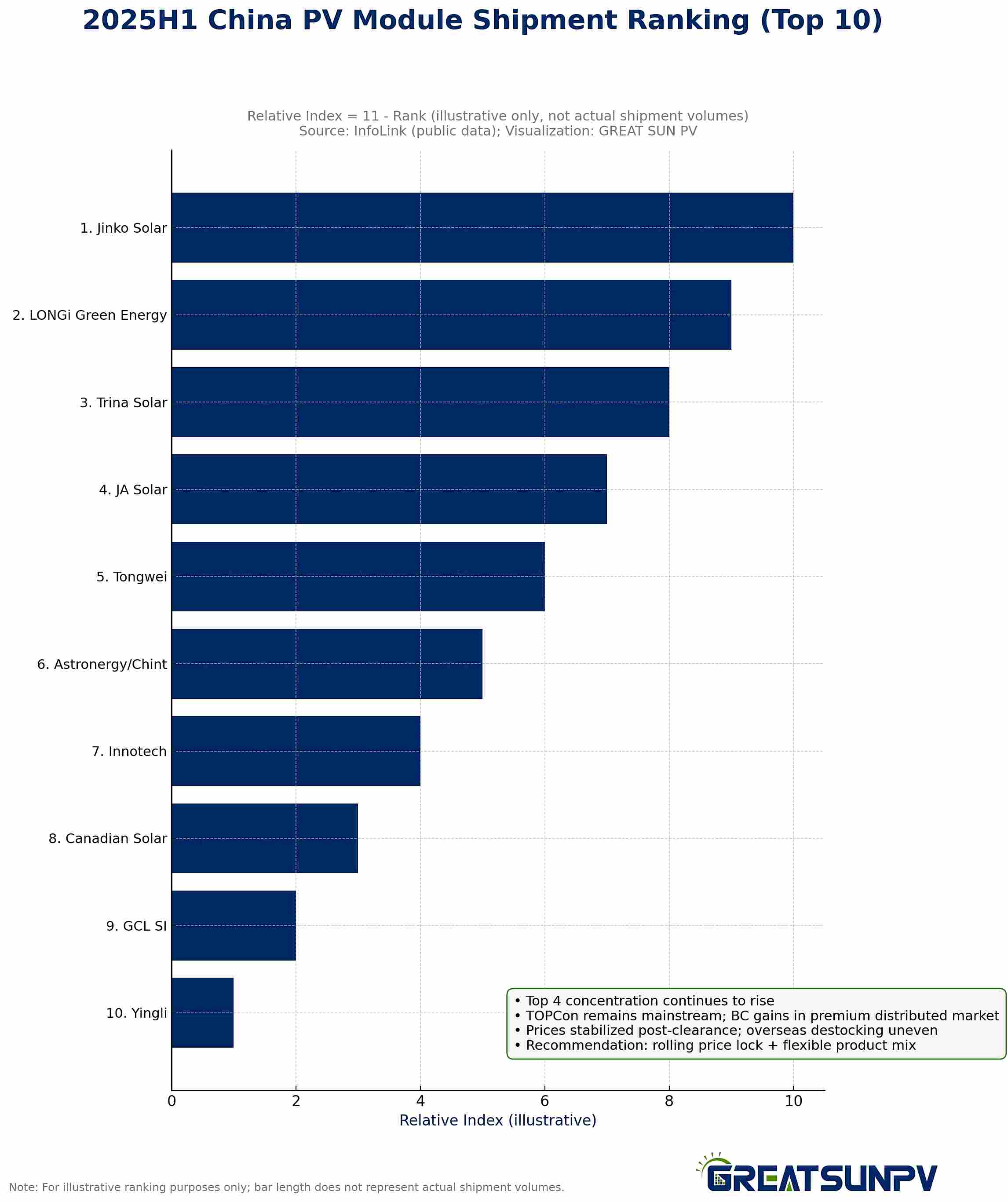
Recently, InfoLink released its 2025H1 global PV module shipment rankings. According to the report, Jinko, LONGi, Trina, and JA Solar remain firmly at the top, while second-tier manufacturers such as Tongwei, Astronergy, Innotech, Canadian Solar, GCL SI, and Yingli round out the Top 10 list. The data clearly reflects the increasing market concentration and intensifying competition in the photovoltaic industry.


Key Observations

  1. Industry Concentration Rising Further
    The combined market share of the Top 4 module suppliers continues to expand, signaling that industry leaders are consolidating their dominance through stronger technology, brand, and channel advantages. For downstream buyers, this trend implies that choosing Tier 1 suppliers could offer greater assurance in terms of product quality and delivery capacity.


  1. Technology Transition: TOPCon Still Mainstream, BC Gains Traction
    In the first half of 2025, TOPCon technology remained the mainstream choice across utility-scale projects, given its maturity and cost competitiveness. At the same time, back-contact (BC) technology has started gaining traction in premium distributed applications, driven by its higher efficiency and aesthetics. Buyers should stay flexible by balancing both technologies in procurement strategies.

  2. Price and Inventory Dynamics
    After significant price corrections in 2024, module prices in H1 2025 showed signs of stabilization. However, the pace of overseas inventory clearance remains uneven across regions. Developers and distributors should pay attention to localized demand patterns and policy shifts, especially in Europe, the U.S., and emerging markets.

  3. Implications for Procurement
    Considering the current environment, a practical strategy would be rolling price lock-in combined with flexible product mix planning. This approach helps hedge against potential cost fluctuations while ensuring access to next-generation high-efficiency modules when they become commercially viable.

Outlook


Looking ahead to the second half of 2025, the PV industry is expected to maintain steady growth. Market leaders will continue to invest in large-scale manufacturing and next-gen technologies, while smaller players may face challenges in keeping pace. For global buyers and project developers, capturing opportunities in this fast-changing environment requires balancing cost, technology, and long-term reliability.


If you would like to learn more about our products, please visit our website: https://www.guruidepv.com

China’s Solar Module Prices Begin to Rise Amid Industry Restructuring

After nearly two years of steep declines, China’s photovoltaic (PV) module prices are now showing a clear upward trend. Recent shifts in supply dynamics, production policy, and upstream costs are driving this change, marking a new phase for the global solar industry.


Supply Tightening and Cost Recovery
China’s solar supply chain has entered a period of consolidation. Government efforts to curb overcapacity and promote “orderly competition” have led to temporary production cuts and stricter quality standards for polysilicon, the core raw material for solar cells. As a result, polysilicon and wafer prices have climbed, pushing module prices higher across both domestic and export markets.


Industry Self-Discipline and Policy Adjustments
Major manufacturers have reduced utilization rates following months of losses, restoring margin discipline to the sector. At the same time, the removal of certain export rebates and adjustments in government tender rules have created a more sustainable price floor. These changes have improved profitability expectations and encouraged longer-term planning across the value chain.


Global Market Impacts
According to recent analyst estimates, Chinese module prices are expected to increase by mid- to high-single-digit percentages in the near term, partially reversing the steep declines of 2024. Developers and EPCs worldwide are urged to revisit their procurement strategies—especially those relying on short-term spot purchases.


“After a period of irrational price competition, the market is normalizing,” said one Shanghai-based industry analyst. “This price recovery will support the financial health of manufacturers and stabilize supply reliability for overseas buyers.”


For global solar developers, this rebound signals the need for more flexible procurement and financing models. Fixed-price contracts, diversified sourcing, and phased purchasing can help mitigate volatility as the market adjusts.


The recent rebound in China’s module prices is less a crisis than a correction—an essential step toward a more balanced and sustainable global solar industry.


If you would like to learn more about our products, please visit our website:https://www.guruidepv.com

Choosing the Best Battery for your Solar System

Power Your Home, Day and Night: Choosing the Best Battery for your Solar System


So, you've got solar panels soaking up the sun, or you're planning to install them. Fantastic! The next step towards true energy independence and resilience is adding a solar battery. But with various options on the market, how do you choose the best solar battery system for your unique home? Let's break down the key considerations:


1.Battery Capacity (kWh): Your Energy Reservoir

Think of this as the size of your fuel tank. It dictates how much energy the battery can store, determining how long it can power your home at night or during an outage.

Key Question: Do you primarily want to shift solar power for evening use, or do you need robust backup power for extended outages? Backup needs often demand a larger capacity.


2.Power Output (kW): Running Your Appliances

Capacity tells you how long, power output tells you how much you can run at once. There are two crucial ratings:

Peak Power: The maximum burst of power (e.g., starting a fridge compressor or well pump). Can your battery handle your biggest motor starting up?

Continuous Power: The steady power it can deliver for hours. Can it run your essential circuits simultaneously?

Key Question: What critical appliances (fridge, medical equipment, AC?) do you need to run during an outage? Discuss your specific needs with your installer.


3.Warranty & Longevity: Protecting Your Investment

Warranties typically range from 5 to 15+ years. Look for the warranty period alongside the expected lifespan.

Pro Tip: Consider the ease of warranty claims. A local manufacturer might offer faster support. Always clarify warranty terms with your retailer.


4.Durability: Charge Cycles & Depth of Discharge (DoD)

Charge Cycles: This is the number of times a battery can be charged and discharged before its capacity significantly degrades. Look for 4,000 to 6,000 cycles or more for long-term value (roughly 10-16 years of daily cycling).

Depth of Discharge (DoD): Using 100% of a battery's capacity every time stresses it and shortens its life. Most batteries specify a recommended maximum DoD (e.g., 90%). Respecting this DoD is crucial for longevity.


5.Efficiency: Minimizing Energy Waste

No battery is 100% efficient. Some energy is lost during charging and discharging. Higher efficiency means more of your precious solar energy powers your home.

Aim High: For lithium-ion batteries (the most common type for homes), seek efficiency ratings of 90% or above.


6.Smart Features & Monitoring: Stay in Control

Many modern systems offer apps and online portals for remote monitoring. Track energy production, consumption, and battery status in real-time. Some integrate with home energy management systems for optimized usage and potential savings.


Choosing the Right Size: It's Personal!

Finding your perfect battery size isn't one-size-fits-all. It depends on:

Your Solar PV System Size: How much excess energy do you typically generate?

Your Daily Electricity Consumption: How much power do you use, especially overnight?

Your Usage Patterns: When do you use the most energy?

Backup Power Goals: How many days of outage coverage do you desire? (Critical medical equipment? Frequent outages?).

Budget: Battery costs vary significantly.

Future Plans: Switching from gas to electric heating/cooking? Factor in future increased demand.


How Will YOU Use Your Battery?

Overnight Power? Size your system so excess solar fully charges the battery by day, covering your typical nighttime needs. Calculate: (Total Avg Daily Energy Use) - (Avg Daily Solar Energy Used) = Excess Solar for Charging Battery.

Backup Power? Crucial! Not all batteries provide backup during grid outages. If outages are common or you have critical needs:

       Discuss backup capabilities with your system designer.

       Consider a battery large enough for multiple days of essential usage.

       Explore adding a generator (e.g., diesel) for extended resilience.


The Key Takeaway:

Choosing the best solar battery is about matching technology to your specific home energy profile and goals. Don't navigate this alone! Consult an accredited solar retailer or installer like GREATSUNPV. They can analyze your electricity bills, solar production data, backup requirements, and future plans to recommend the optimal battery capacity, power output, and features for your household. Investing in the right battery unlocks the full potential of your solar panels, providing savings, security, and true energy independence. Find the suitable batteries for your home, check here https://www.guruidepv.com/lithium-battery_c2


Europe Accelerates Solar Installations with Focus on Hybrid Projects and Grid Integration

Europe’s solar sector is scaling at record pace in 2025, reinforcing its role as a cornerstone of the continent’s clean energy transition. According to industry reports, the European Union added more than 70 GW of new solar capacity in H1 2025, a sharp increase compared with the same period in 2024, making the region one of the fastest-growing PV markets worldwide.


This momentum reflects both policy support and market demand. The EU’s REPowerEU plan and country-level auctions in Germany, Spain, and Italy continue to drive large-scale deployment, while distributed rooftop installations in France and the Netherlands are adding resilience to local grids.


A defining feature of Europe’s 2025 project pipeline is the surge in hybrid PV-plus-storage plants, designed to stabilize power supply and improve grid flexibility. Battery installations across the region are growing rapidly, with analysts projecting more than 12 GW of new storage capacity by year-end, helping balance intermittent solar generation.


“European developers are no longer building solar plants in isolation — hybrid and grid-smart projects are the new normal,” said a spokesperson from a leading EPC firm. “The emphasis is on accelerated timelines, smarter procurement, and early grid coordination to ensure projects come online smoothly.”


Key priorities shaping project installations include:

  • Grid-readiness: Early engagement with TSOs and DSOs to secure interconnection.

  • Supply resilience: Strategic sourcing of modules and inverters from diversified suppliers.

  • Technology adoption: Strong uptake of single-axis trackers in southern Europe and floating solar in land-constrained regions.

  • Hybrid integration: Co-locating storage to meet both regulatory requirements and market demand.

  •  

With governments pushing toward 2030 renewable targets, Europe’s solar industry is well-positioned to maintain double-digit growth. The pace of installations is not only strengthening energy security but also reinforcing Europe’s leadership in the global clean energy transition.


If you would like to learn more about our products, please visit our website: https://www.guruidepv.com